
Which Vallejo Records Are Open
Access depends on the record, not just the name in it. Vallejo ordinances and prior city requests have direct web channels. Solano County offers public indexes for recorded documents and assessment data, but recent vital certificates follow copy-eligibility rules. Court dockets exclude confidential material, and voter files have separate limits. The table distinguishes an online finding aid from the copy channel that produces a usable record.
| Record set | Custodian | Online index | Coverage and access |
|---|---|---|---|
| Deeds, liens, easements, maps | Solano Recorder | Official Records Search | Index from 1955; older research in office; images not online |
| Assessment and parcel data | Solano Assessor and GIS | Property Search and Parcel Viewer | Current APN, address, assessment, parcel, and map channels |
| Civil, criminal, family, probate, traffic | Solano Superior Court | Account-required Public Portal | Daily case data; confidential files withheld; certified copies from division |
| Birth, death, marriage | Solano Recorder and CDPH | No unrestricted recent-copy index | Solano events since 1845; authorized or informational copy rules |
| City agendas, ordinances, permits, reports | City of Vallejo | Revver, online services, NextRequest | Online files or CPRA request, subject to redaction |
| Jail and booking data | Solano Sheriff | Inmate Search and booking logs | Selected current data; booking log covers the last seven days |
California law does not make every government-held detail public. Sealed cases, juvenile and adoption files, protected addresses, medical records, confidential voter data, motor-vehicle data, and parts of active police investigations can be closed or redacted. A public index also is not proof that every document behind the index may be viewed.
Vallejo Recorder Records Stop Online
The Solano County Recorder keeps deeds, liens, easements, map filings, and other official real-property records in perpetuity. Its computers and online index search back to 1955. Records from 1954 and earlier require the office research area in Fairfield. That cutoff matters in Vallejo, where many older neighborhoods and Mare Island-era property trails predate the web coverage.
The index has a second, less obvious limit: document images do not display online. Searchers can identify a recording, then request a regular or certified copy by mail or in person. Copies cost $9 for the first page and $1 for each added page. Certification adds $5. The Recorder's official copy instructions show the coverage boundary and copy route.
The copy route is separate from a newer county safeguard that mails property owners notice after certain deed-related recordings. An alert does not replace checking the index or ordering the underlying document.
Note: A portal result is an index entry, while a certified copy is the office-authenticated document used when formal proof is required.
Search Vallejo Recorder Records Precisely
The Official Records Search supports much more than a single name box. A grantor is the party transferring an interest, while a grantee receives it. Trying both roles and narrowing the date or document class can separate people who share a name. The exact fields shown can vary by document class.
| Official field | Input type | Required | Format or use |
|---|---|---|---|
| Document Type | Dropdown | Implicit | Selects the document class |
| Search For | Text | No | APN, names, document number, or date |
| By Name | Text group | No | Last, first, middle; business-name format available |
| Primary, Secondary, Tertiary Name | Text groups | No | Additional indexed parties |
| Document Date | Date range | No | From and To in mm/dd/yyyy format |
| Document Number | Numeric range | No | Beginning and ending numbers |
| Assessor Parcel Number | Text | No | APN or customized searchable field |
| Book and Page | Dropdown and text | No | Book type, book number, page number |
Results can lead to party names, document type, recording date, document number, book and page, and parcel references. Those are index concepts supported by the portal and county instructions. Because no live sample record was captured in the research, the result screen should not be assumed to show owner addresses or every named party in the same format.
Vallejo Property Records Use Three Systems
Solano property research divides by task. The Assessor Property Search accepts an assessor parcel number, known as an APN, or a street address. Its tips advise entering less text and omitting street types and compass directions when a search fails. The Parcel Viewer adds parcel lines, city boundaries, roads, address points, and aerial context.
Neither map context nor assessment data replaces a recorded deed. The Assessor identifies taxable property and maintains values, exemptions, the assessment roll, and parcel maps. GIS shows where a parcel sits. The Recorder supplies the indexed legal-document trail. Permit and code records may also appear through Solano Accela by address, parcel, property owner, or record information, though the exact public result fields were not confirmed.
For scale, the county reported more than 154,000 parcels and a $77.96 billion assessment roll for fiscal year 2025/26. That count explains why an APN is often more exact than a street line.
Vallejo Court Records Require Accounts
State trial matters from Vallejo route to Solano Superior Court, not a separate municipal court. The Solano Superior Court Public Portal covers civil, criminal, traffic, family, and related case data, with probate handled by court divisions. Registration requires an email address, password, name, phone number, agreement to the terms, and then login before Case Search.
A case number is the simplest search. Without one, the portal instructions allow last name, first name, company name, or a filed-date range. Person and company names require at least two characters. Data updates daily, but confidential cases and documents do not appear. An electronically viewed trial-court record is not the official certified record unless the court electronically certifies it.
The fallback is the clerk division. A record search and copy form accepts a case number or person name, date of birth, case type, filing year, requested documents, and regular, certified, or exemplified copy choice. Submit a separate request to each division. A $15 search fee applies if staff research exceeds ten minutes.
Note: Federal cases connected to Vallejo use PACER and the Northern District of California, not the Solano court portal.
Vallejo Vital Records Have Copy Tiers
The Solano Recorder issues birth, death, and marriage certificates for county events since 1845. California uses authorized and informational certified copies. Both copy the original record, but an authorized copy requires eligibility under Health and Safety Code section 103526(c). Mail and online requests for an authorized copy need an application and notarized sworn statement. Confidential marriage certificates are limited to the spouses or a court-authorized requester.
The Solano vital-records channel accepts requests in person, by mail, or online. County fees are $36 for birth, $28 for death, and $21 for marriage certificates; online service adds $7. The fee is kept if no record is found. Statewide CDPH files begin in July 1905, so earlier research should begin with the county where the event occurred.
A recent certificate is not an open name directory. Historical indexes held by archives and genealogy groups can serve as finding aids, but they are not certified proof. Divorce files belong to Superior Court; a CDPH certificate of record is not the full court case.
Vallejo Public Records Office Routes
Vallejo is not the Solano County seat. The main recorder, assessment, civil-court, and sheriff records counters are in Fairfield. City records stay with Vallejo departments. Calling the correct desk before travel can confirm whether a file is online, available at a counter, or restricted to a written request.
Solano Assessor/Recorder
675 Texas Street, Suite 2700
Fairfield, CA 94533
707-784-6290
Sheriff Records/Warrants
530 Union Avenue, Suite 100
Fairfield, CA 94533
707-784-7010
Reports, warrants, jail information, vehicle releases
Vallejo City Records
City department custody
Online request channel
Requests, ordinances, minutes, permits, police records
The Recorder public counter is open Monday through Friday from 9 a.m. to 4 p.m.; document recording closes at 3:30 p.m. Older official records are researched in its office area. Court copies come from the division that holds the case. Police reports use the Vallejo Police Records Section or the city request portal, depending on the record.
Vallejo Jail and Police Records
The Solano inmate locator provides selected custody information as a public service. The Sheriff warns that it is informational, not an official record, and may have errors or omissions. Confirm an identity or custody fact through the jail or Records/Warrants Bureau rather than treating a similar name as proof.
The county's jail booking log page covers arrests booked into Solano County jail during the last seven days and refreshes nightly. The log is released under Government Code section 7923.610.
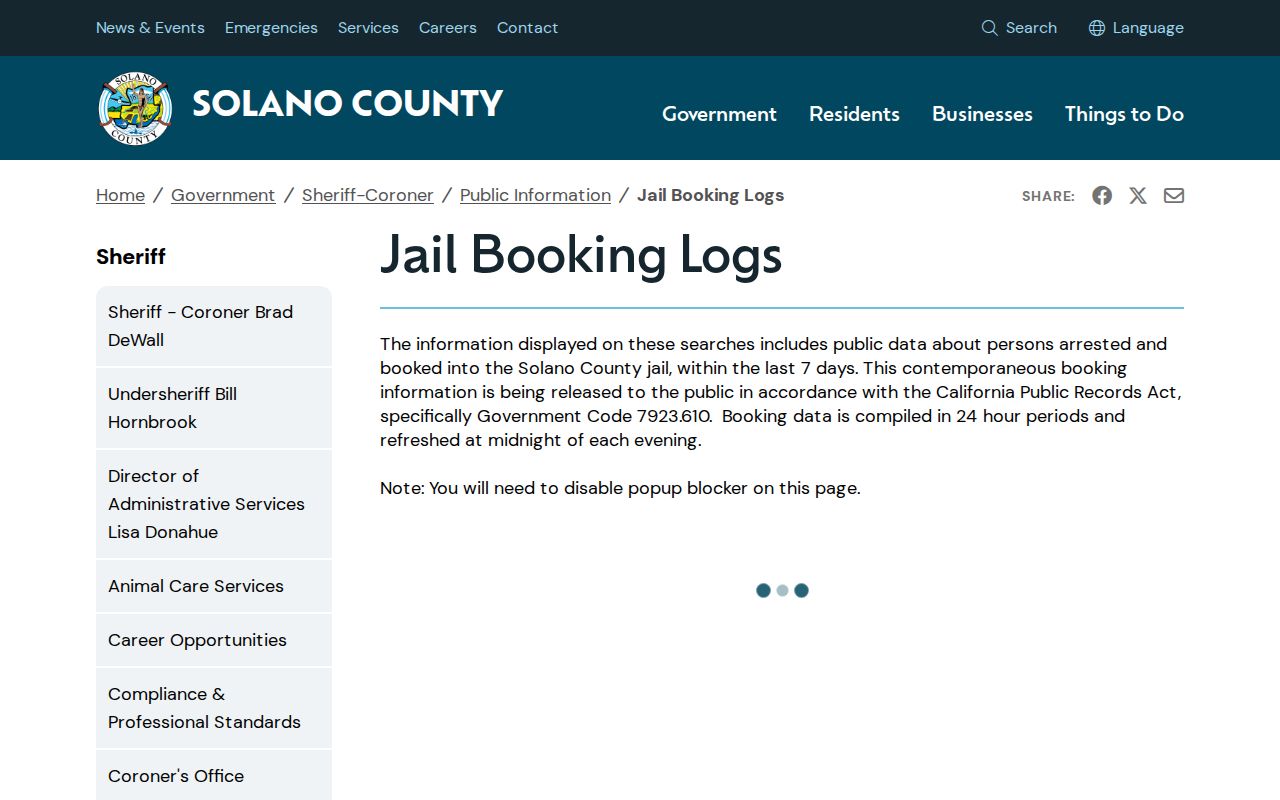
The screenshot reinforces the log's narrow time window. Older or official confirmation must go through the Sheriff, while a Vallejo police-report copy goes through the Police Records Section or a city request.
California's CDCR search covers state prison custody, not the county jail. Megan's Law is a separate DOJ registry with strict legal-use rules. Active investigations, victims, juveniles, medical facts, and confidential sources can lead to police-record redactions.
California Records Extend Vallejo Searches
Some records are created and kept at the state level. California's Secretary of State hosts business-entity and UCC searches. DCA and separate boards publish professional license status and discipline. CDCR provides selected state-custody facts, and the State Controller holds the official unclaimed-property search. These systems fill a gap only when the state agency is the actual custodian.
The California business search can show entity names, numbers, filing addresses, registered agents, and filing history where available.
The portal's own disclaimer matters: online business data is not a complete or certified record. Formal copies and certification follow Secretary of State order procedures.
- Custodian
- The agency or office responsible for holding and responding for a record.
- Index
- A searchable list that points to a filing; it may not display the document image.
- Certified copy
- A copy authenticated by the office as a true copy of its record.
- Exemption
- A legal ground that permits or requires an agency to withhold information.
What Vallejo Records Stay Restricted
Open government and personal privacy operate side by side. The California Public Records Act reaches disclosable agency files, but other laws protect sealed court matters, juvenile cases, adoption files, confidential marriages, medical and mental-health records, voter identifiers, and motor-vehicle information. A court order, Safe at Home status, or a specific address-protection law can also remove details from ordinary release.
Data-broker deletion rights do not erase a deed, docket, assessment entry, or other official filing from government custody. They apply to covered private businesses. Likewise, voter data is not a general address list: full birth dates, signatures, driver's-license details, Social Security number digits, and confidential-voter records are withheld, and full-file use is limited by election law.
Use records lawfully. Public access never authorizes stalking, harassment, threats, surveillance, or doxxing. Verify identity before drawing conclusions from a name match.
Solano Recording Alerts Add Protection
Solano County launched its Recording Notification Program in summer 2025. It sends a letter when someone records a deed, quitclaim deed, or deed of trust against a participating owner's property. The notice is an early warning, not a ruling that a filing is valid or fraudulent.
The official recording notification page explains the county program.
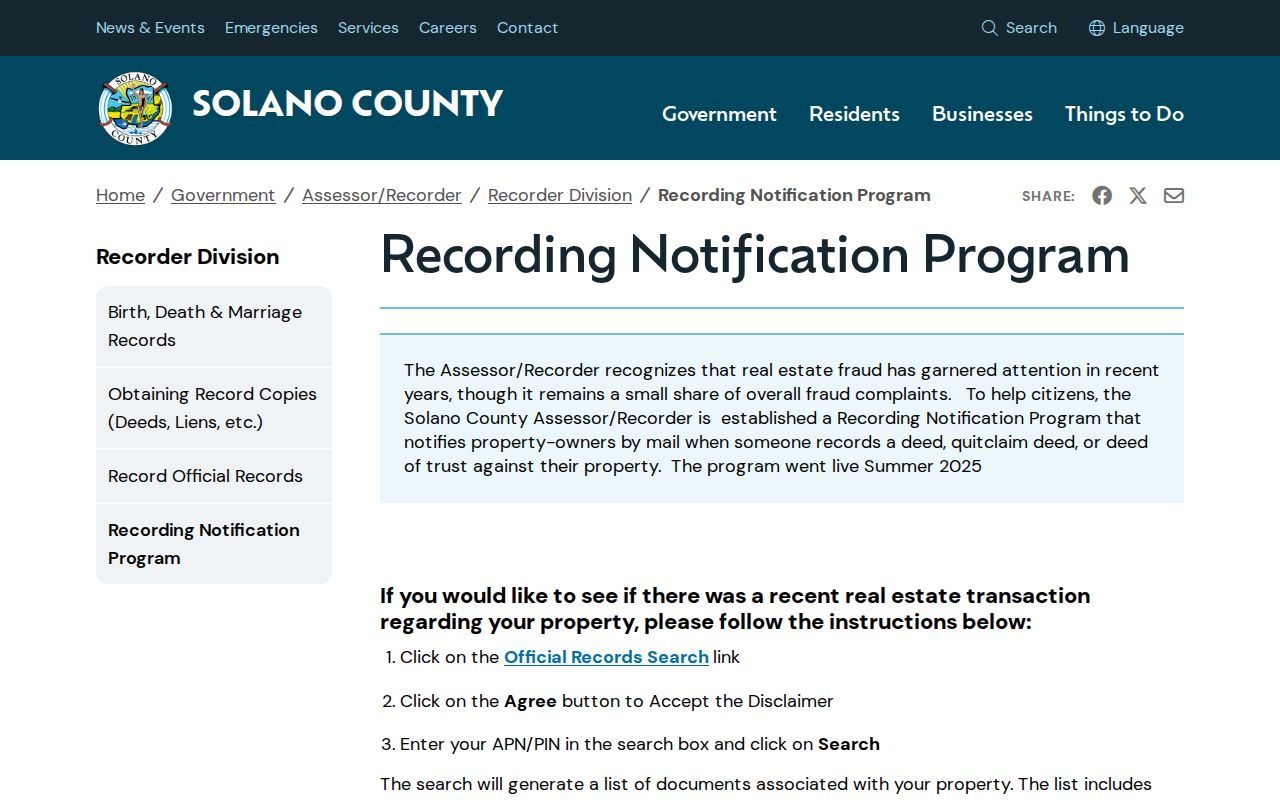
A mailed alert should be checked against the Official Records Search and, when needed, a purchased copy from the Recorder. That direct check helps distinguish an actual filing from an inflated private deed-copy solicitation.
Requesting Vallejo Public Records
The California Public Records Act, Government Code sections 7920.000 through 7931.000, allows any person to request disclosable state or local agency records. Residency is not required. An agency generally has ten days to decide whether responsive, disclosable records exist. Unusual circumstances can add fourteen days. Direct duplication costs and fees set by another statute may apply, but a general review charge is not the default.
Use the City of Vallejo channel only for city-created material. The Vallejo NextRequest form accepts new requests, while its public archive can reveal a prior response.
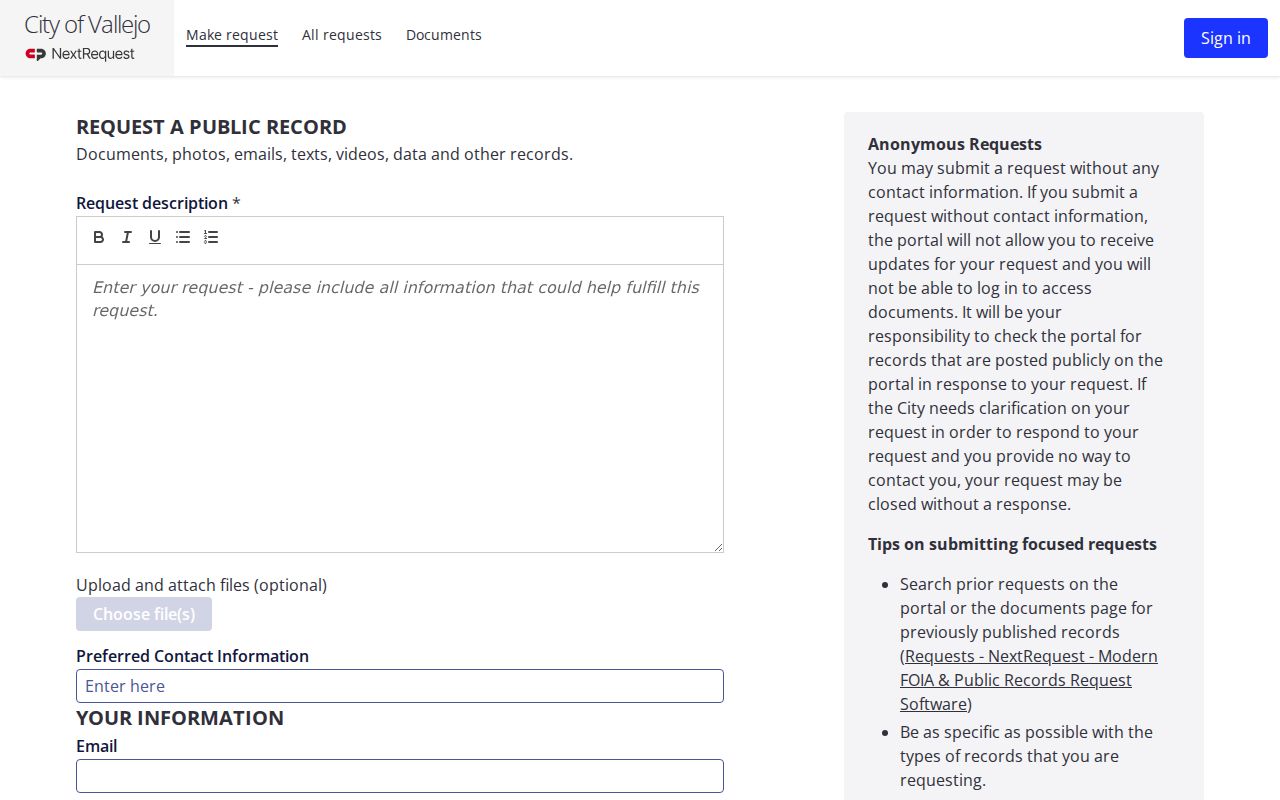
The form gives city requests a trackable route. Solano deeds, court files, vital certificates, and sheriff material still go to their own custodians.
- Choose the custodian. Decide whether Vallejo, Solano County, a court, or California created and holds the record.
- Check the existing channel. Search the index, archive, counter system, or published log before making a broad request.
- Describe existing records. Give names, date ranges, record type, address, APN, case number, or document number, plus the desired electronic or paper format.
- Review the response. The agency may produce records, cite exemptions and redact parts, seek an extension, or explain that it holds no responsive file.
- Narrow or challenge when needed. Clarify an overbroad request, ask for the legal basis of a denial, then use agency counsel or court enforcement if the dispute remains.
Agencies must search for existing material; they do not have to create a new report or answer a question. The current California Public Records Act text controls when a portal summary and the statute differ.